

Henry James's long sentences
Are they unreadable?

English departments in many universities across the world are typically divided into three units: linguistic studies, literary studies and medieval studies. In the past these disciplines have not always seen eye to eye: literary scholars often looked askance at their linguist colleagues, and questioned the value of studying texts using linguistic tools, such as grammar. Linguists in their turn bemoaned the intuitive anything-goes approach to literary studies.
Things have long changed.
At the 2026 English Grammar Day, organised by UCL, the British Library and the University of Oxford, there was an interesting talk by Greg Tate of the University of St Andrews about H. G. Wells and the Evolution of Grammar (see Tate forthcoming). In his talk Tate asked: “How can the details of English grammar help us to study and interpret literature, and specifically the distinctive literary styles of writers from different periods of literary history?” Studies like this are part of the field of Literary Linguistics (or Stylistics), which bridges the gap between linguistic and literary studies.
His talk reminded me of an excellent 2014 PhD Dissertation written at UCL by my student Lesley Moss who worked on Henry James’s style, specifically his syntax. To study his grammar, Moss compiled her own Henry James Parsed Corpus (HJPC), which allowed her to grammatically analyse several works by James from his earlier and later periods.
It’s well-known that Henry’s James’s writing became more complex towards the end of his life. Moss cites two literary scholars writing on James’s style:
James's late style can be called either mannered or Mannerist, depending on whether one views his hesitations and qualifications, his inversions and twisting of syntax, his mingling of literary with colloquial language as an artifice masking an emptiness of content or as a mode of expression reflecting his painstaking effort to communicate with precision refinements of feeling and thought. (Hopkins, 1968: 113)
[The three late novels] are notorious for their difficulty … The notation is almost excessively fine, the issues often appear tenuous, the atmosphere has been pumped ‘gaspingly dry’. Readers who delighted in the pictorial brilliancy of his earlier work and its neatness of style, must now grope in a world where for all the animation of James’s figurative speech both meaning and action often hang in suspense; they must give unremitting attention to a new kind of discourse – the passional language of disembodied intelligences. (Gifford, 1983: 126)
Let’s have a look at some of James’s work for examples of the late style.
He used long sentences, very long sentences. Here’s the longest one he wrote from his ‘middle period’ (so not yet his late style):
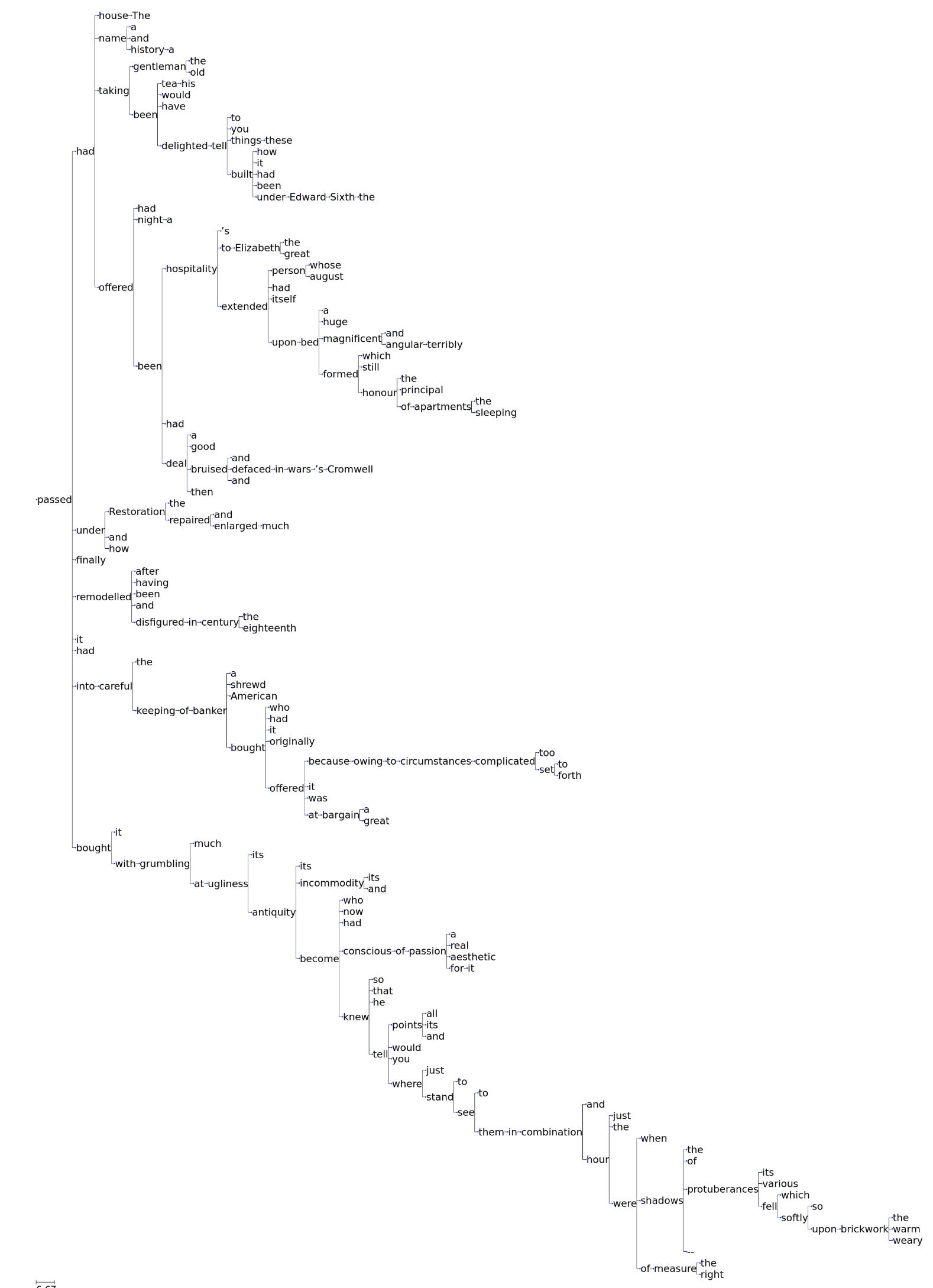
The house had a name and a history; the old gentleman taking his tea would have been delighted to tell you these things: how it had been built under Edward the Sixth, had offered a night’s hospitality to the great Elizabeth (whose august person had extended itself upon a huge, magnificent and terribly angular bed which still formed the principal honour of the sleeping apartments), had been a good deal bruised and defaced in Cromwell’s wars, and then, under the Restoration, repaired and much enlarged; and how, finally, after having been remodelled and disfigured in the eighteenth century, it had passed into the careful keeping of a shrewd American banker, who had bought it originally because (owing to circumstances too complicated to set forth) it was offered at a great bargain: bought it with much grumbling at its ugliness, its antiquity, its incommodity, and who now, at the end of twenty years, had become conscious of a real aesthetic passion for it, so that he knew all its points and would tell you just where to stand to see them in combination and just the hour when the shadows of its various protuberances—which fell so softly upon the warm, weary brickwork—were of the right measure. (Henry James, The Portrait of a Lady, 1881)
This is quite readable, despite being long and complex. Jonathan Reeve has analysed this sentence syntactically. Here is his schematic representation:
But what about James’s late style? Take a look at this example from The Golden Bowl (1904):
She had got up with these last words; she stood there before him with that particular suggestion in her aspect to which even the long habit of their life together had not closed his sense, kept sharp, year after year, by the collation of types and signs, the comparison of fine object with fine object, of one degree of finish, of one form of the exquisite with another–the appearance of some slight, slim draped ‘antique’ of Vatican or Capitoline halls, late and refined, rare as a note and immortal as a link, set in motion by the miraculous infusion of a modern impulse and yet, for all the sudden freedom of folds and footsteps forsaken after centuries by their pedestal, keeping still the quality, the perfect felicity, of the statue; the blurred, absent eyes, the smoothed, elegant, nameless head, the impersonal flit of a creature lost in an alien age and passing as an image in worn relief round and round a precious vase. (The Golden Bowl, chapter 10)
Phew.
In a departmental seminar at UCL, in which a Henry James specialist presented a talk, I asked — safely from the back of the room — with an innocent face: “Was the late Henry James perhaps just a terrible writer?”
Heads turned, and looks of incomprehending and undiluted fury were cast in my direction. While I understand the Jamesians’ ire, I’m not alone in my dislike of the late style. Even James’s own brother, the philosopher and psychologist William James, asked for a more accessible style:
Why don’t you, just to please your Brother, sit down and write a new book, with no twilight or mustiness in the plot, with great vigor and decisiveness in the action, no fencing in the dialogue, no psychological commentaries, and absolute straightness of style? (Quoted in Parker 1984: 496)
More recently, writing on an edition of Henry James’s prefaces of his own works in the London Review of Books (Herford 2024), Colin Burrows writes :
The prefaces display all the mannerisms of James’s late style, which, as you chew your way through, begin quite quickly to gnaw at the gut like some terrible recycling of regurgitation. Adverbs, frequently misplaced (exquisitely, refinedly) for emphasis, come to sound like little more than pauses in the dictating voice, as James seeks, hesitatingly, to resist saying the obvious. He loved to put a familiar or vulgar phrase in inverted commas, as though to show he was above it, or that it wouldn’t quite ‘do’, and italicised the simplest of words as though that would make them carry the most complex of meanings. These mannerisms don’t always make for lucidity. … James wanted every sentence to be artful. What he could often forget, later in life, is that some sentences just need to say what they need to say. (LRB 15 August 2024)
Burrows’ manducatory troubles accord with my own literary dyspepsia when reading the late James, so I won’t even try to grammatically analyse the sentence above, despite my professed love of nerdy grammar. I have a feeling you wouldn’t even want me to.
But let me stop there. I’ve probably alienated enough readers.
What’s your view? I’d really like to know what you make of James’s late style, specifically the sentence above. Drop me a line in the comments.
I’m prepared for some flak…..
PS Despite my qualms about Henry James, his brilliant quotation about London is to my mind the best characterisation of that amazing city ever written:
It is difficult to speak adequately or justly of London. It is not a pleasant place; it is not agreeable, or cheerful, or easy, or exempt from reproach. It is only magnificent. You can draw up a tremendous list of reasons why it should be insupportable. The fogs, the smoke, the dirt, the darkness, the wet, the distances, the ugliness, the brutal size of the place, the horrible numerosity of society, the manner in which this senseless bigness is fatal to amenity, to convenience, to conversation, to good manners – all this and much more you may expatiate upon. You may call it dreary, heavy, stupid, dull, inhuman, vulgar at heart and tiresome in form. ... But these are occasional moods; and for one who takes it as I take it, London is on the whole the most possible form of life. ... It is the biggest aggregation of human life – the most complete compendium of the world.
References
Burrow, Colin (2024) ‘Just say it, Henry’. London Review of Books. Vol. 46, No. 16.
Gifford, H. (1983) Henry James: the drama of discrimination. In: B. Ford (ed.) The New Pelican Guide to English Literature. London: Penguin. 115-130.
Herford, O. (2024) The prefaces by Henry James, edited by Oliver Herford. Cambridge: Cambridge University Press.
Hopkins, V. (1968) Visual art devices and parallels in James. In: T. Tanner (ed.) Henry James: modern judgements. London: Macmillan. 89-127.
Moss, Lesley (2014) Corpus stylistics and Henry James’s syntax. PhD Dissertation UCL.
Parker, H. (1984) ‘Henry James “In the wood”: sequence and significances of his literary labors, 1905-1907’. Nineteenth-Century Fiction. Vol. 38, No. 4. Special Issue Dedicated to Blake Nevius. University of California Press. 492-513.
Reeve, Jonathan (2017) ‘The Henry James sentence: new quantitative approaches’.
Tate, Gregory (forthcoming) Grammar and style in Victorian literary culture. Edinburgh: Edinburgh University Press.
What stopped me in that second sentence was "rare as a note, immortal as a link". How are notes rare? OK, eventually I decided it was probably rare as in "attenuated, rarefied, subtle". But what's immortal about a link? Is it any more immortal than anything else made of metal? By the time I decided to give up on that question, I'd lost my place in the sentence.
And "forsaken after centuries by their pedestal"? Does James really mean that the *pedestal* forsakes the *statue*, not vice versa? I think he's just lost track of what he was saying by that point. (Too bad, since the alliteration of for/freedom/folds/footsteps/forsaken is very nice.)
The sentence about the house is no problem, even though it's longer. It doesn't have weird similes, it has plenty of parallel structures, it has parentheses to let you know which parts are digressions, and the main sequence is straight chronological order.
I love many such sentences in isolation and was unduly delighted by your diagramming, but the accumulation of such sentences, combined with James's obsessive psychological hair-splitting, can keep me from enjoying late James as much as his dedicated fans do. The James I like best is the author of "Daisy Miller."
A late-James exception is "The Beast in the Jungle," which is a masterpiece because the point is that nothing happens, in great detail, for quite a long time, which is far more interesting in its nullity than nullity typically is. The form matches the absence of matter.