

We saw in the blog post Form and function (1) that grammatical form and grammatical function are not always clearly kept apart in the National Curriculum.
Recall that ‘form’ refers to the category labels that we use for the building blocks of language, i.e. word classes (e.g. noun, verb, adjective, etc.), phrases (e.g. noun phrase, adjective phrase, etc.) and clauses (e.g. relative clause). By contrast 'function' refers to the grammatical functions (e.g. Subject, Object, Adverbial, etc.) that the various building blocks can perform.
In this blog post we'll look at some further example of sentences analysed at the levels of form and function.
Consider the following sentences:
They closed the cinema last month.
The weather improved over the weekend.
He is an electrician.
The radio played a track that I love.
This class will visit a museum next week.
The paper has published the allegations.
The president hasn't appeared on the news since the scandal erupted.
These are analysed as follows using boxes to indicate the form (blue) and function (orange) levels.
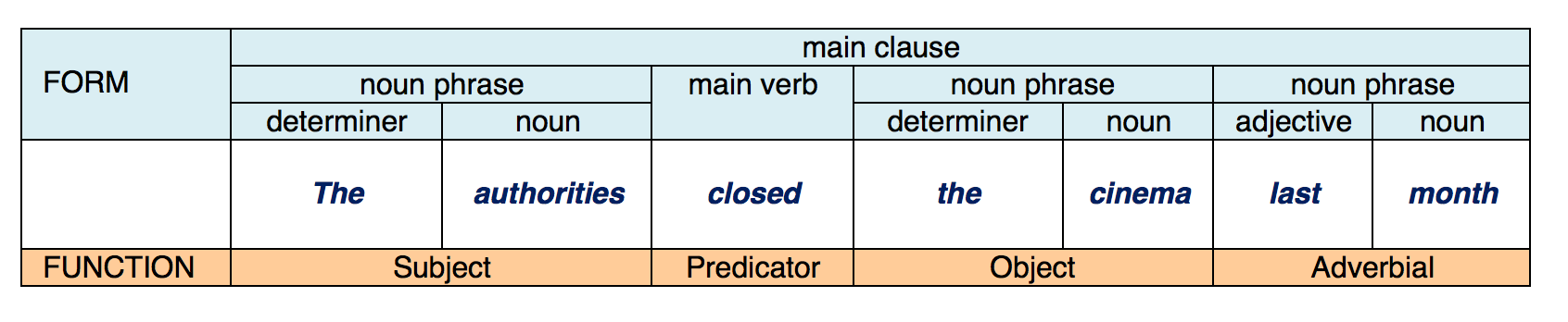
This is a simple sentence containing a Subject, Object and Adverbial. Each of these take the form of a noun phrase. The verb in this example is transitive, which simply means that it takes an Object. Notice that the verb carries the function label of Predicator. This term is not statutory in the National Curriculum, but useful to know.

In this case we again have a Subject in the form of a noun phrase. The verb on this occasion is intransitive, i.e. it does not take an Object. It is followed by a preposition phrase that functions as Adverbial.

In this sentence the Subject takes the form of a pronoun. The verb is a special kind of verb called a linking verb (also called copula). The noun phrase that follows it functions as Subject Complement. The latter gives information about the Subject. (Incidentally, if you are wondering why he is not a noun phrase, remember that in the National Curriculum a word on its own does not form a phrase. In some models of grammar he would be both a pronoun and a noun phrase.)
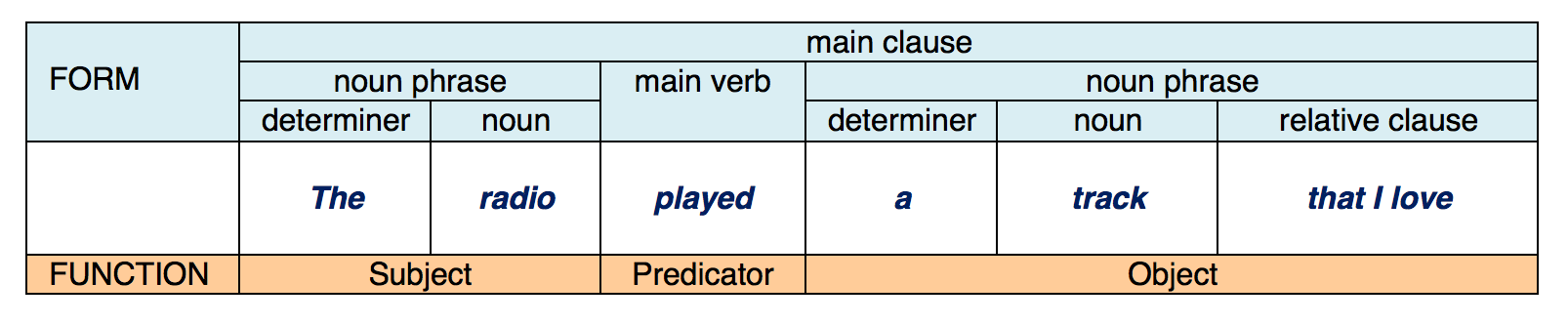
Here again we have a sentence that contains a transitive verb (play). Both the Subject and Object are in the form of a noun phrase. In this case the noun phrase that functions as Object has a relative clause inside it. Relative clauses give additional information about the noun they go with, in this case track.
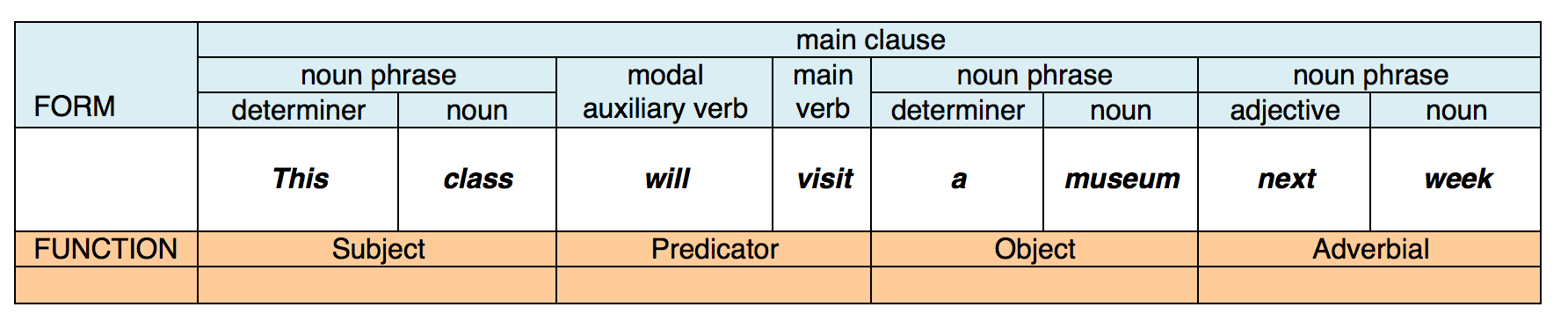
In this example the Subject and Object are again in the form of a noun phrase. We also have an Adverbial in the form of a noun phrase. This sentence shows very clearly why we should keep the levels of form and function apart: a noun phrase can perform different kinds of functions. What about the verb? Well, in this case we have two of them: visit is the main verb, preceded by the modal auxiliary verb will. The latter indicates that 'visiting a museum' is an event foreseen in the future.
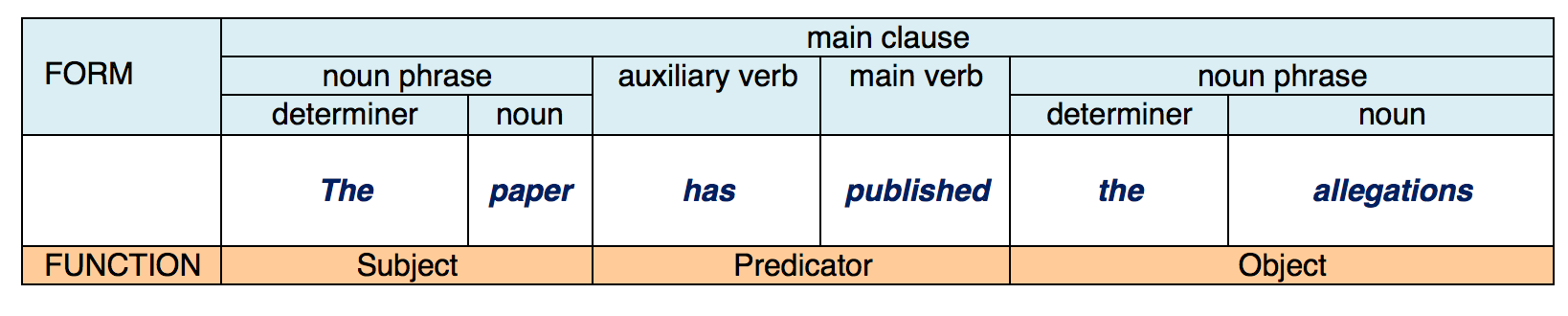
In this example, apart from a Subject and Object in the shape of a noun phrase, we again have two verbs, namely the auxiliary verb have and the past participle form of the main verb publish. Together these two verbs form the perfect form of the verb have.

In this last example the verb is intransitive. It is followed by two units functioning as Adverbial: one is a preposition phrase; the other is a subordinate clause introduced by the subordinating conjunction since. Within the subordinate clause the scandal functions as Subject. Because erupt is an intransitive verb, there is no Object in this clause.